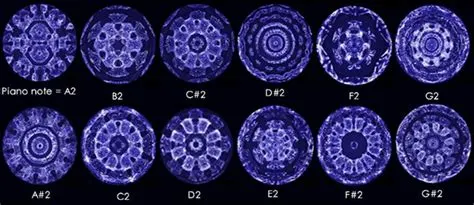
"Kyma" in Greek means wave. Cymatics is the visual observation of sound, the observation of the product of sound on matter. The term cymatics was introduced in 1967 by a Swiss physicist named Hans Jenny, in his book Cymatics: "The Study of Wave Phenomena", a photographic documentation that describes the effects of sound and its vibrations in fluids and powders. His conclusion: "This is not an unregulated chaos; it is a dynamic but ordered pattern". And what a wonder... Jenny's experiment used a crystal oscillator to vibrate a membrane over which he placed sand. It was observed how the sand spontaneously produced symmetrical patterns. Lower tones created simpler and clearer images, higher tones more complex structures. It takes our breath away when we finally manage to capture what we have between our hands: it strongly reminds us of the mystery of the most abstract or divine. We live surrounded by such inexhaustible, instantaneous beauty and we cannot, distracted, almost notice it. But don't believe me, press play.
"It is not an unregulated chaos; it is a dynamic but ordered pattern." Hans Jenny, in his book "Cymatics: The Study of Wave Phenomena" (1967).
EXPERIMENT #1: AQUATIC MEDIUM

In this experiment, water is used in a glass container placed over a speaker, where a spoken voice will be heard. The water contains dye that, thanks to precise lighting, allows us to observe very closely the unexpected and complete marvel of the geometric arrangement that all sound, ultimately, is. In the second part, we see how a slightly thick powder, which could be sand or some salt, is added to the water, and we can see the different but dazzling response of this added material to the water.